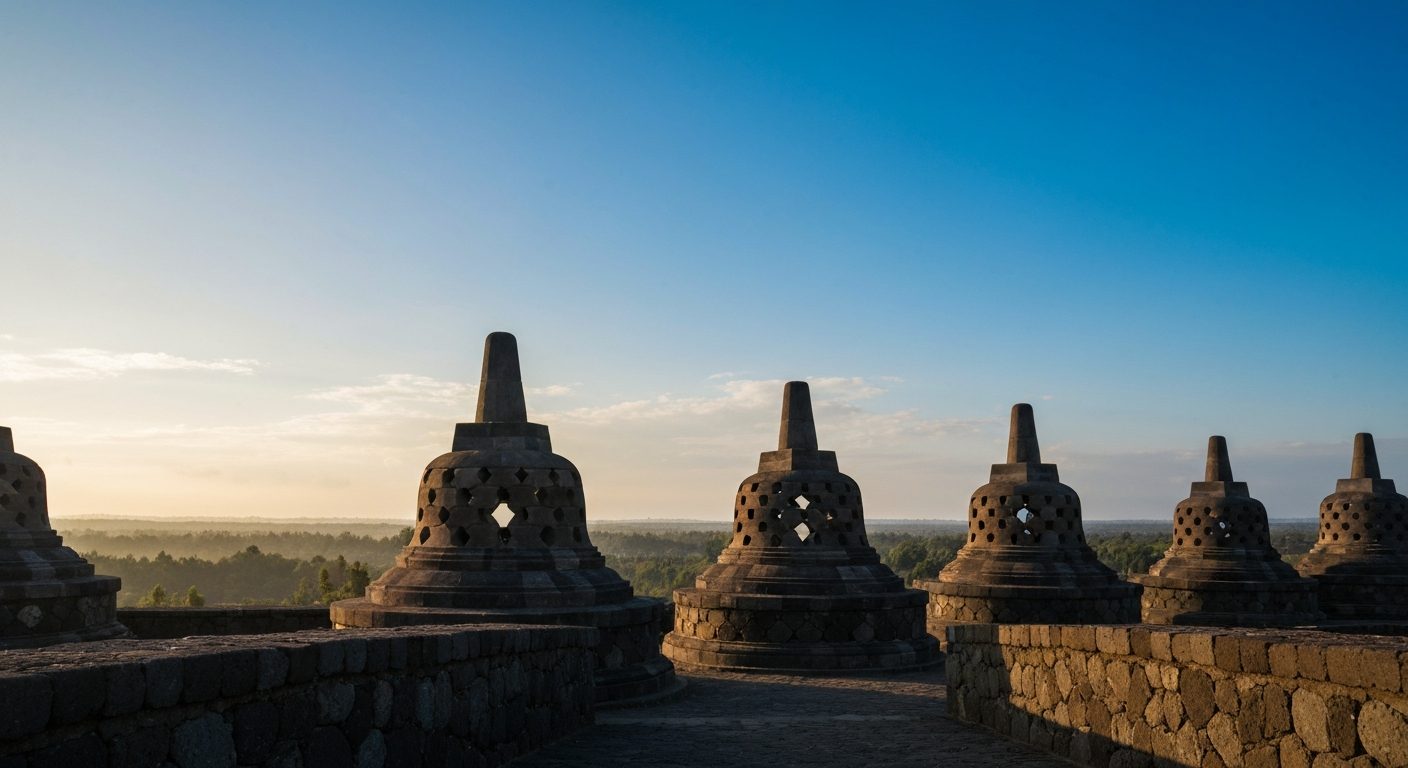
Java landmarks things to see are the big-ticket places that define a Java overland circuit: Bromo’s caldera at sunrise, Ijen’s crater, Borobudur and Prambanan temples, plus waterfalls like Tumpak Sewu. This guide is a plain-spoken Java Indonesia travel guide for Bali-based travellers who want to add East and Central Java without turning their holiday into a logistics puzzle.
As Bali Premium Trip’s Java overland routing editor, I spend most of my time doing one thing: turning the messy mix of ferries, pre-dawn hikes and train connections into clear private itineraries that our Bali reservations team can actually deliver with vetted local operators. This page is that planning brain, written down.
—
Why Java is the natural “beyond Bali” add-on
If you already have flights into Denpasar and a base in Bali, Java is your logical next step. Think of it as:
- Volcano and culture extension rather than a replacement for Bali
- A 3–7 day add-on that fits around your existing island time
- A way to see Bromo, Ijen, Borobudur and Prambanan without juggling six different booking tabs
Most Bali-based travellers ask two questions first:
- What are the key Java highlights from Bali?
- How do they line up on an overland route that doesn’t feel rushed?
This guide answers both, then flags 2026 Java tourism trends and route updates that affect real itineraries.
—
Java at a glance: the main circuit from Bali
For a simple mental map, imagine Java laid out east to west:
- Bali – Ketapang / Gilimanuk ferry crossing
- Ijen crater (East Java)
- Mount Bromo and Tengger caldera (East Java)
- Tumpak Sewu waterfall (East Java, south side)
- Yogyakarta for Borobudur and Prambanan (Central Java)
Most East Java overland tour highlights from Bali follow some variation of this line, run either:
- Bali → Ijen → Bromo → Yogyakarta, or
- Bali → Ijen → Bromo → back to Bali, if you don’t have time to continue west
Typical private overland trips:
- Short East Java focus: 3–4 days (Ijen + Bromo from Bali, return to Bali)
- Classic Java highlights: 5–7 days (Bali → Ijen → Bromo → Yogyakarta for Borobudur & Prambanan, then fly back)
- Extended multi-destination: 8–10 days (Bali → Java highlights → onward to Flores/Komodo by flight, the common “Bali Java Komodo 10 day itinerary multi destination” pattern)
Driving distances are real.
- Gilimanuk to Ketapang ferry is around 45–60 minutes pier-to-pier.
- Ketapang to Bondowoso (Ijen access) is around 3–4 hours by car, depending on traffic and stops.
- Bondowoso to Bromo area is typically 5–7 hours, with mountain roads slowing you down.
You can fly, you can train, and we absolutely help choose between them, but the core experiences — Bromo sunrise, Ijen crater, Tumpak Sewu trailheads — are overland.
—
Key Java landmarks and things to see from Bali
1. Mount Bromo & the Tengger caldera
Mount Bromo is the volcano even non-hikers recognise from photos: a smoking cone at around 2,329 m sitting inside a huge sand-filled caldera. For many travellers asking what to do in East Java, Bromo is the first answer.
Where it fits on the route
- East Java, inland from Probolinggo
- Usually visited after Ijen if you’re coming overland from Bali
- Rough drive times:
- Ketapang (Ijen side) to Bromo area: ~6–7 hours with breaks
- Bromo area to Surabaya Airport (SUB): ~3–4 hours
What the actual experience looks like
A typical Bromo morning run from the village side (Cemoro Lawang or similar) looks like this:
- Wake-up around 02:30–03:00
- Private car to the jeep base, 20–40 minutes depending on where you stay
- 4×4 jeep to sunrise viewpoint, often Penanjakan area or Kingkong Hill, another 30–45 minutes
- Watch first light hit the caldera, then drop into the Sea of Sand
- Optional walk and stair climb to Bromo’s rim (the crater lip hike itself usually takes 10–20 minutes from the base, not counting photo stops)
You don’t need to be an alpine climber. The day is long and cold at the start, but the walk itself is short and manageable for most people with average fitness.
Logistics that matter in 2026
- National park access now uses daily quotas and timed entries in high season. Your guide or trip operator must pre-register vehicle plates and visitor names.
- Local jeep cooperatives control access inside the park; we arrange these with licensed drivers, but we don’t own the jeeps ourselves.
- Crowd levels are highest on weekends and Indonesian holidays; sunrise viewpoints can get busy. We adjust schedules and choice of viewpoints to reduce that impact where possible.
For many travellers, Bromo is the “this feels like another planet” day that balances Bali’s beaches.
—
2. Ijen crater and the blue fire
Ijen is known for two things: the turquoise acid lake and the electric-blue fire visible in the darkness when conditions cooperate. It sits at ~2,386 m and is usually your first major Java stop once you’re over from Bali.
Where it fits on the route
- East Java, inland from Banyuwangi and Bondowoso
- Closest Java landmark to the Ketapang–Gilimanuk ferry
- Typical sequence from Bali:
- South Bali to Gilimanuk: 4–5 hours by road
- Ferry crossing: 45–60 minutes
- Port to Ijen-area accommodation: 1.5–3 hours, depending on side (Banyuwangi vs Bondowoso)
The pre-dawn hike, step by step
- Depart hotel around 00:30–01:30, depending on park entry slot
- Drive 45–90 minutes to the parking area
- Hike ~3 km up to the crater rim, usually 60–90 minutes for most visitors
- Optional guided descent inside the crater to try to see the blue fire, only allowed in specific conditions and under ranger/guide control
- Sunrise over the crater and lake, then descent and return to the hotel for late breakfast
The path is clear but climbs steadily. If you handle a 5–7 km city walk with some hills at home, you’ll likely be fine here with enough breaks.
Safety and changes
- Ijen is an active volcanic environment. Indonesian authorities close access when gas levels spike or conditions are unsafe. No operator can override this.
- The blue fire is never guaranteed. It depends on gas flow, wind and visibility. Most honest operators, including us, now describe it correctly as “possible, not promised”.
- Sulphur miners still work there. Your guide will brief you on distance and photography etiquette so visits stay respectful.
We use licensed local mountain guides for Ijen. They manage pace, mask usage and safe timing for any descent into the crater.
—
3. Borobudur: the world’s largest Buddhist temple
Borobudur is the big Central Java landmark that turns an East Java trip into a complete Java Indonesia travel guide circuit. It’s one of Southeast Asia’s most important Buddhist monuments, dating to the 8th–9th centuries.
Where it fits on the route
- Around 40 km northwest of Yogyakarta
- Typically visited after Bromo, with an overland or rail link to Yogyakarta, or a flight via Surabaya if you’re short on time
- Standard patterns:
- Bromo → train from Probolinggo or Malang → Yogyakarta
- Bromo → Surabaya → short domestic flight → Yogyakarta
Travel times vary, but plan on:
- 3–4 hours Bromo → Surabaya (car)
- 50–60 minutes Surabaya → Yogyakarta flight, plus airport time
- Or ~7–9 hours total if you prefer the scenic train route via economy or executive class
How visits work now
Recent years brought several changes to manage visitor impact:
- Access to the top terraces is restricted and quota-based. You now pre-book time slots for “structure access” versus “ground-only” tickets.
- Footwear rules: conservation programs may require soft sandals or covers for those going up onto the main structure. Gear is usually provided onsite.
- Guided tours are highly recommended to make sense of the relief panels. We arrange licensed cultural guides locally; we don’t send Bali staff to pretend to be experts.
Typical visit durations:
- Ground-only overview: 1.5–2 hours
- Full structured visit with guide: 2.5–3.5 hours
If you’re building a “Java highlights Borobudur Bromo Ijen from Bali” route, Borobudur is usually a half-day anchored in an otherwise relaxed Yogyakarta day.
—
4. Prambanan: Java’s major Hindu temple complex
Prambanan is the Hindu counterpart to Borobudur, with tall pointed towers and intricate stonework. It’s dedicated mainly to Shiva, with origins in the 9th century.
Where it fits on the route
- Around 17 km east of central Yogyakarta
- Often combined with:
- Morning at Borobudur, afternoon or sunset at Prambanan, or
- A dedicated half-day visit and, in season, an evening Ramayana dance performance in the open-air theatre
Travel time from central Yogyakarta to Prambanan is usually 30–45 minutes by private car, depending on traffic.
What the visit looks like
- Main inner complex with the three largest shrines
- Smaller surrounding temples and a scattered archaeological park
- Museum and interpretation areas
Plan on 2–3 hours onsite for a comfortable visit, excluding any evening performance.
For many travellers, Borobudur and Prambanan together are what justify continuing from East Java to Central Java rather than turning back toward Bali after Bromo.
—
5. Tumpak Sewu waterfall
Tumpak Sewu is the big vertical curtain waterfall you’ll see all over Java social media: a semi-circular wall of water dropping into a misty basin. It sits in Lumajang Regency, on the southern side of East Java, roughly between Bromo and Malang.
Where it fits on the route
- Around 2–3 hours drive from Bromo area, depending on exact start point
- Around 2–3 hours from Malang city
- Can be added:
- Between Bromo and Malang
- Or as a dedicated day trip from Malang if you’re not doing Bromo
Trail and timing
Expect:
- Steep descent via steps, ladders and sometimes wet rock
- A mix of concrete, bamboo and natural paths
- Variable conditions after heavy rain
The out-and-back walk often takes 2–3 hours for reasonably fit travellers, not counting photo time at the base. It’s not a flat stroll; this is a proper leg-day. Good footwear, dry bags and acceptance of getting muddy are all part of the experience.
We generally suggest Tumpak Sewu only to guests comfortable with heights and non-urban trails. It’s one of the East Java overland tour highlights, but not compulsory for everyone.
—
How the Bali–Java route actually works
You can see the big names now. The next practical question: how do they line up into real days without turning your trip into a zombie march of 2am alarms?
A simple way to think about it is in modules, which we then combine into a custom route.
Common overland modules from Bali
- Bali → Ijen (1 day transfer + 1 night)
- Day road transfer (4–5 hrs) to Gilimanuk, ferry (45–60 mins), then 1.5–3 hr drive to Ijen-area stay. Night in East Java.
- Ijen hike → transfer to Bromo
- Pre-dawn hike (midnight–08:00 window), rest and check out, then 5–7 hour drive to Bromo area. Night near Bromo.
- Bromo sunrise → onward travel
- 02:30–10:00 Bromo run, late breakfast, then either 3–4 hr drive to Surabaya or 2–3 hr to Malang for Tumpak Sewu or train/flight connections.
- Bromo / Malang → Yogyakarta
- Day train (7–9 hrs) via Malang or Surabaya, or 50–60 min flight plus airport transfers.
- Yogyakarta temples
- 1–2 days split between Borobudur and Prambanan, plus city time if desired.
A few route patterns we build often:
- 3D2N Bali–Ijen–Bromo–Bali
- For travellers short on time who want only East Java.
- 4D3N Bali–Ijen–Bromo–Surabaya/Malang
- Ends in East Java city for onward flights.
- 5D4N or 6D5N Bali–Ijen–Bromo–Yogyakarta
- Adds Central Java temples.
- 8–10 days Bali–Java–Komodo
- Uses Bali as the air hub to connect Java highlights with a Flores/Komodo leg by domestic flight.
These aren’t off-the-shelf obligations. They’re starting points the Bali Premium Trip team adjusts for your flight times, tolerance for early mornings, and desire for downtime.
—
2026 Java tourism trends, new routes and access updates
A few 2026 trends affect how we plan routes and what to do in East Java without frustration.
1. Quotas and timed entries are the new normal
- Bromo and Ijen: park authorities continue to manage visitor numbers, especially around weekends and long Indonesian holidays. Expect pre-registration of visitor data and vehicle plates.
- Borobudur: stricter caps on visitors going onto the top levels, with timed windows. Ground-level visits are more flexible but can still be crowded in peak season.
For you, this means we lock in permits and slots early in the planning process instead of “we’ll just see when you arrive”.
2. Overland vs flights: more domestic options, still weather-dependent
By 2026, domestic air routes give more flexibility, especially:
- Multiple daily flights Surabaya ↔ Yogyakarta and Surabaya ↔ Bali (DPS)
- Seasonal and schedule-adjusted flights Yogyakarta ↔ Labuan Bajo (Komodo) for those building a Bali Java Komodo 10 day itinerary multi destination
That said:
- Schedules shift. We design overland legs so your trip still works if an airline adjusts timings within reason.
- We treat short-haul flights as time-savers, not as the backbone of the experience. The core Java landmarks still require overland access.
3. More travellers, but also more route creativity
The classic “everyone at the same sunrise viewpoint” formula is still very visible. Yet local operators and national park authorities are gradually opening and formalising:
- Alternative Bromo viewpoints that trade proximity for fewer crowds
- Staggered Ijen start times where gas/safety allow, spreading hikers out over the night
Our job in 2026 isn’t to claim we can “avoid all crowds” — that would be dishonest — but to steer you to timing and routes that feel more human.
—
Cost ranges and practical expectations
We don’t post one-size-fits-all prices on this page, because private Java overland trips vary with:
- Group size
- Accommodation standard
- Season
- How many flights vs overland legs you include
That said, indicative ranges last verified June 2026 for private, not shared, trips can help your budgeting:
- 3D2N Bali → Ijen → Bromo → Bali or Surabaya
- Often lands somewhere around US$450–900 per person for 2–4 travellers sharing, depending on hotel level and inclusions.
- 5–7 day Bali → Ijen → Bromo → Yogyakarta (temples)
- Commonly in the US$850–1,800 per person band for 2–4 travellers, again highly dependent on room type and any domestic flights added.
These are broad ranges, not quotes. They usually cover:
- Private vehicle and driver for overland legs
- Local licensed guides for Ijen, Bromo and temple days
- Basic park fees and jeep cooperatives where needed
- Accommodation on a twin-share basis
They usually do not include:
- Long-haul flights to/from Indonesia
- Most lunches/dinners (we keep this flexible)
- Personal equipment rental beyond basics (e.g. hiking poles, heavy-duty cold-weather gear)
To get a real figure for your specific dates and preferences, it’s faster to ask the team directly. You can plan your trip with our Bali Premium Trip reservations staff via email or WhatsApp; they price in Indonesian rupiah with transparent breakdowns and no third-party markups.
—
Comparing Java’s headline highlights
Here’s a simple comparison table to help you decide what to prioritise if time is tight:
| Site | Main draw | Time needed onsite | Fitness level | Best joined with |
|---|---|---|---|---|
| Ijen crater | Lake, sulphur mining, possible blue fire | Pre-dawn to late morning (6–8 hrs incl. hike) | Moderate: 3 km climb | Bali entry/exit, Bromo |
| Mount Bromo | Volcanic caldera sunrise, crater rim | Pre-dawn to mid-morning (5–7 hrs) | Light: short walks, some stairs | Ijen, Tumpak Sewu, Surabaya/Malang |
| Tumpak Sewu | Large multi-drop waterfall | Half day (2–3 hrs trail) | Moderate–high: steep, wet paths | Bromo, Malang |
| Borobudur | Buddhist temple, reliefs | 2–3 hrs | Light: steps but no hike | Prambanan, Yogyakarta city |
| Prambanan | Hindu temple complex | 2–3 hrs | Light | Borobudur, Ramayana show |
If you only have 3–4 days free from Bali, focus on Ijen + Bromo.
With 5–7 days, add Borobudur and Prambanan and you’ve covered the essential Java landmarks things to see.
—
Who does what: our role vs local partners
Bali Premium Trip runs the planning, the reservations and the overall trip structure from our Bali base. You book directly with us at published, transparent rates; there’s no external agent adding hidden markups in the middle.
On the ground in Java:
- Drivers and vehicles are operated by licensed Java-based transport companies we’ve worked with for years.
- Mountain and cultural guides for Ijen, Bromo, Borobudur, Prambanan and Tumpak Sewu are local specialists, not imported generalists.
- National park permits, jeeps and tickets are arranged directly with the relevant authorities and local co-ops in your name.
Our job is to stress-test every plan against real drive times, ferry delays and your sleep needs, then match that plan to partners who can realistically deliver it.
If you’re trying to decide if Java is the right extension to your Bali trip, or curious how a Bali Java Komodo 10 day itinerary multi destination could work in your dates, you can use us as a sounding board. Start a chat with our planners via plan your trip and they’ll answer by email or WhatsApp.
—
FAQs
How many days do I need to see the main Java highlights from Bali?
For Ijen and Bromo only, allow at least 3 days and 2 nights starting and ending in Bali. To add Borobudur and Prambanan in Yogyakarta, most travellers are happier with 5–7 days so drives and early starts don’t stack up too hard.
Is an overland Java tour a good alternative to just staying longer in Bali?
If you enjoy landscapes, cooler temperatures and big cultural sites, then yes, Java is a strong alternative use of your extra days. It doesn’t replace Bali’s beaches and food scene; it adds volcanic hikes and major temples that Bali simply doesn’t have.
Can I do Ijen and Bromo with children or older travellers?
Many families and older guests visit both. Bromo is generally easier, with vehicle access close to key viewpoints and short walks. Ijen’s 3 km climb is more demanding; we adjust pace, start times and sometimes suggest skipping the crater descent and blue fire attempt for those who prefer a calmer rim-only visit.
What’s the best season for an East Java overland tour?
The drier months generally run from April to October, with clearer skies more common. Rainy season (roughly November to March) can still work, but trails like Tumpak Sewu become wetter and cloud cover is more likely at viewpoints.
How do I start planning a Bali–Java itinerary with you?
Send your Bali dates, group size and must-see list via our plan your trip page. Our Bali Premium Trip team replies by email or WhatsApp with a draft route, realistic drive times, and price ranges tailored to your season, then refines it with you before any payment is taken.