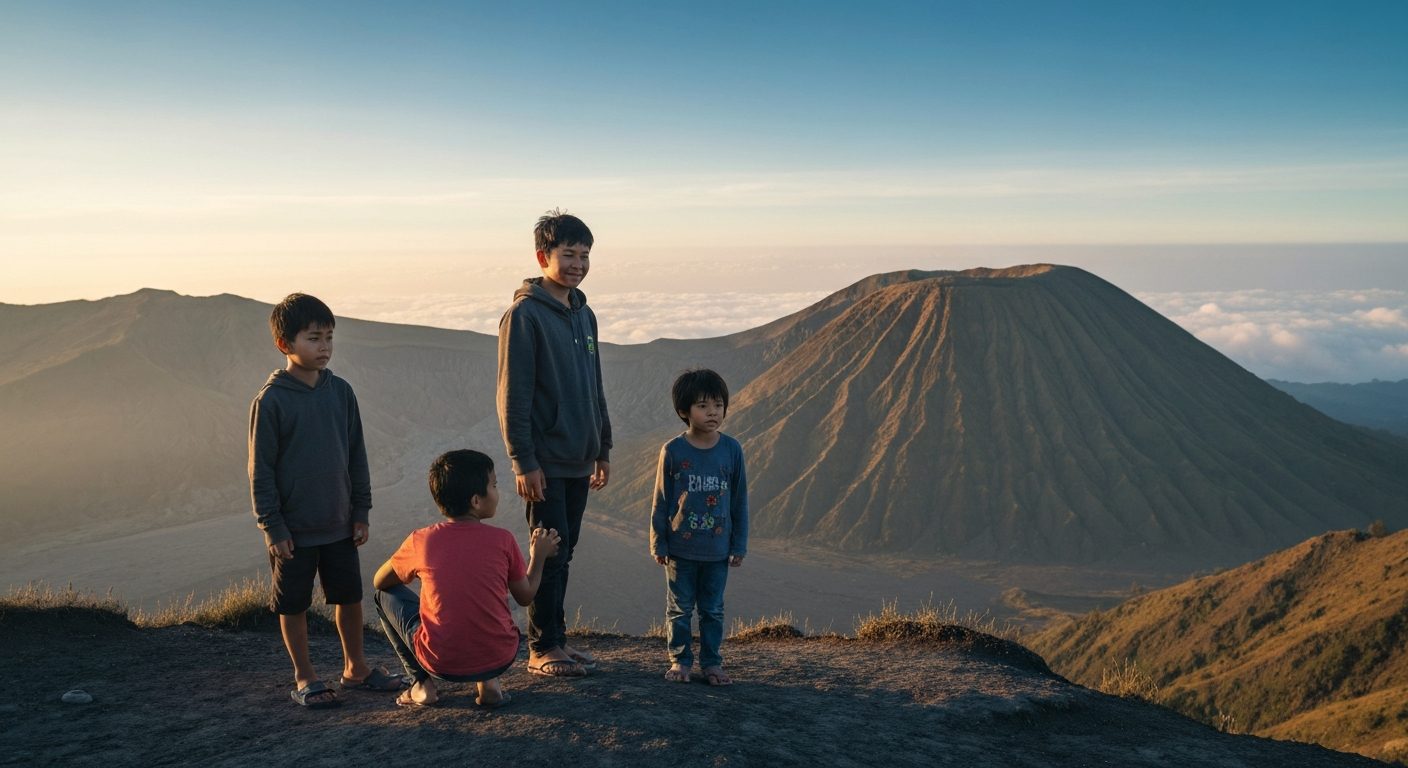
Can you do Bromo and Ijen with kids from Bali? Yes, you can — but it is not one-size-fits-all, and Ijen in particular is not suitable for every child. Age, health, and your tolerance for midnight wake-ups all matter more than glossy photos.
I’m Java Overland Tour Editorial Desk, trip planning and safety researcher at Java Overland Tour, operated by Bali Premium Trip. My job is to help families decide if a Java family tour Bali combo with kids is realistic, safe, and enjoyable before you even think about paying a deposit.
This page walks through:
- Which ages tend to cope well with Bromo, Ijen, Borobudur and Prambanan
- The real hazards: sulfur gas, night hiking, altitude, ferries, and long drives
- How a family-friendly Bali and Java volcano tour is usually structured
- Alternatives and swaps for younger children or anxious parents
Use this as a planning filter. Then, once you’ve decided your “yes / no / maybe” for each site, our reservations team can help you plan your trip over email or WhatsApp with realistic timings and licensed local guides.
—
1. Big Picture: Is a Bali + Java Volcano Trip Family-Friendly?
A family-friendly Bali and Java volcano tour usually means:
- Starting in Bali
- Crossing to East Java (Ketapang – Banyuwangi port)
- Visiting Ijen and/or Bromo
- Optionally continuing across Java to Yogyakarta for Borobudur and Prambanan
- Then flying back to Bali or onward to Jakarta / Singapore
From a family point of view, the trip has three main stress points:
- Night wake-ups (often 2–3 am for Ijen, 3–4 am for Bromo sunrise)
- Long transfers (several 4–6 hour driving blocks plus a ~1 hour ferry)
- Volcanic conditions — sulfur gas at Ijen, dust and wind at Bromo, cooler temperatures (often 5–15°C at viewpoints)
The reward:
- Kids see real volcanoes, calderas and lava landscapes instead of just textbook pictures
- Teenagers get an educational trip to Borobudur and Prambanan that ties together religion, history, and architecture
- Families experience a very different side of Indonesia beyond beach clubs and Bali rice terraces
But not every family enjoys this. Some are happier keeping Java to gentler sites or skipping Ijen entirely.
—
2. Age-by-Age Guide: Toddlers, School-Age Kids, Teens
Toddlers (0–4 years): Bali-focused, Java only in special cases
For a Bali Java tour with toddler vs teenager, the toddler side is the most limiting.
- Ijen: I do not recommend the crater hike with toddlers. The path is steep, often dark, and sulfur gas exposure is unpredictable. Most responsible local operators will either refuse or strongly discourage infants and very young children.
- Bromo: More feasible, because jeeps go close to viewpoints and the main walking is on sandy tracks and a stairway. The main issues are cold temperatures at sunrise and the early start.
- Borobudur/Prambanan: Possible, but toddlers will not get much educational value and may overheat or tire quickly in daytime heat.
For this age, a “Java light” plan could look like:
- One night in Cemoro Lawang or nearby for Bromo sunrise (with enough rest on either side)
- Skip Ijen
- If you add Yogyakarta, do short, stroller-friendly visits at Borobudur and Prambanan, and keep flexible timings
School-age kids (5–11 years): Best balance for most families
This is usually the sweet spot for a java family tour Bali combo with kids.
- Many 6–11-year-olds can handle the Bromo sunrise schedule if you plan naps carefully.
- Fit, motivated children 8+ sometimes manage Ijen in daylight hours (not the crowded blue-fire rush), provided the operator and guide agree and the parents understand the risks.
You still need to factor:
- Motion sickness on long car rides
- Reaction to cold and wind at altitude
- Fear of dark paths or crowds at early-morning viewpoints
Tweens & Teens (12–17 years): Most flexible, big educational upside
For teenagers, Java can be a true field trip:
- Bromo: The scale of the Tengger caldera is easy to grasp from the viewpoints; they’ll remember the sand sea, the smell of sulphur, and the jeep ride.
- Ijen: Older, fit teens with no respiratory problems may be suitable for a daytime crater rim hike with masks and proper guidance. Many operators will set minimum age limits here; expect stricter rules than for Bromo.
- Borobudur & Prambanan: These shine at this age. A guide can explain Buddhist relief panels, Hindu epics, and the shift between religions on Java. History or art students get a lot out of an educational trip for teens to Borobudur and Prambanan.
Teens also cope better with midnight alarms and long drives, though you still need to schedule recovery time.
—
3. Bromo with Kids: What’s Realistic and Safe?
Mount Bromo is usually the easier volcano for families, and it’s a core part of a family-friendly Bali and Java volcano tour.
What actually happens on a Bromo sunrise tour?
Most private family itineraries run something like this (times are approximate):
- 03:00–04:00: Jeep picks you up from your hotel in Cemoro Lawang or nearby
- 04:30–05:30: Reach a viewpoint area above the caldera; short walk from the jeep parking
- 05:30–06:30: Watch sunrise and the light over Bromo, Batok, and Semeru
- 06:30–08:30: Drive down into the caldera, optional walk or horse ride across the “Sea of Sand” to Bromo’s crater stairs (around 250–300 steps)
- 09:00–10:00: Return to hotel for breakfast and rest
Total time out: about 5–6 hours.
Minimum age for Bromo sunrise tour with kids
There’s no legal “minimum age Bromo sunrise tour kids” rule applied across the whole park. Instead:
- Many family-focused operators are comfortable taking children 4–5 years and older, if they are healthy and the parents feel confident with the early start and chill.
- Infants are technically allowed, but long cold waits in the dark are uncomfortable and risk hypothermia if clothing is inadequate.
Always confirm with your chosen operator at booking what ages they accept and how they adapt the plan for younger kids (later start, shorter viewpoint visits, etc.).
Main risks and how they’re usually managed
Not medical advice — these are practical considerations you can talk about with your doctor and your operator.
- Cold (sometimes 5–10°C at viewpoints)
- Children lose body heat faster. Proper layering (base layer, fleece, windproof jacket, hat, gloves) is non-negotiable.
- Crowds and jeep traffic
- Viewpoints can be very busy in high season and on weekends. We often suggest less-crowded vantage points for families.
- Volcanic ash and dust
- Can irritate eyes and throats; families often carry buff-style face covers or simple masks, plus sunglasses.
- Steep stairs to the crater
- Not suitable for every child, especially in strong wind or if there is noticeable ash in the air. Parents sometimes choose to enjoy the sand sea only.
For children with asthma or other respiratory conditions, you should speak with a pediatrician before visiting active volcanic sites and tell your operator clearly, so they can advise on realistic options and bring this to the local guide’s attention.
—
4. Ijen with Kids: Gas, Night Hikes and Honest Limits
Ijen is more complex. The “blue fire” photos look dramatic, but the conditions are much tougher than Bromo.
What makes Ijen difficult for families?
- Steep hike: 2.8–3 km uphill one way, with 400–500 meters of elevation gain. Adults in average fitness often need 1.5–2.5 hours to the crater rim.
- Sulfur gas: Wind direction can push gas over the trail or rim with little warning. Masks help, but do not fully “solve” gas exposure.
- Darkness: Many tours start around midnight to see the blue fire, meaning rough, dark paths and big crowds at fragile hours.
- Crater descent: The path into the crater to see blue fire is narrow, rocky and slippery. Conditions change often, and access is sometimes restricted.
For these reasons, many operators (including the partners we work with) are increasingly cautious about taking children to Ijen, especially into the crater itself and especially at night.
Is Ijen safe for kids?
“Is Ijen safe for kids?” does not have a yes/no answer. Safety depends on:
- Age, fitness, and ability to follow instructions
- Respiratory health and sensitivity to sulfur gas
- Weather and gas conditions on the day
- How conservative your operator and guide are
Most families who visit Ijen with us now choose a daytime rim-only hike, which avoids the most crowded and gas-heavy hours, and stops at the crater rim rather than going down to the lake.
We do not encourage blue-fire-focused crater descents for children.
For any child with asthma, history of wheezing, or other respiratory concerns, speak to a doctor or pediatrician before you consider Ijen at all. We can discuss the on-the-ground logistics, but we cannot judge your child’s medical suitability.
Age guidelines used by many operators
Every company sets its own rules, but patterns we see in the field:
- Many responsible guides prefer no children under 10–12 on the Ijen trail, and often older for crater descents.
- Some will accept active younger children (around 8–9) for rim-only hikes in daylight, if conditions are good and parents understand the risks.
- If conditions are poor (strong gas, heavy rain), even adults may be turned back at the gate or the rim.
Always verify your children’s eligibility and the planned timing (night vs early morning vs daylight) directly before booking. Do not assume that what you saw in another family’s trip report will be offered to you.
—
5. Bromo vs Ijen vs Borobudur & Prambanan for Families
Here’s a comparison to help you build the best Java itinerary for families from Bali:
| Site | Core Experience | Physical Effort | Key Risks for Kids | Typical Minimum Age (Informal) |
|---|---|---|---|---|
| Bromo | Sunrise viewpoint, jeep ride, sand sea, optional crater stairs | Low–moderate (short walks, stairs if you choose) | Cold, wind, dust/ash, early start, crowds | ~4–5+ years with proper clothing |
| Ijen (rim) | 2–3 hour hike to crater rim, view turquoise lake and miners | Moderate–high (steep uphill, altitude ~2,300 m) | Sulfur gas, darkness if done pre-dawn, tiredness | Often 10–12+ years, healthy & fit |
| Ijen (crater / blue fire) | Steep descent to see flames at night, close to gas source | High (technical sections, poor light) | Significant sulfur exposure, slips, crowding in dark | Many operators now discourage children entirely |
| Borobudur | Buddhist temple, reliefs, stupas, history session | Low–moderate (steps, heat) | Sun exposure, dehydration, boredom for very young kids | Any age with shade/rest; best 10+ for educational value |
| Prambanan | Hindu temple complex, Ramayana stories, wider grounds | Low–moderate (walking on uneven stones) | Heat, some areas with steps | Any age; teens engage most with the stories |
For many families, the most rewarding mix is:
- Bromo + Borobudur + Prambanan
- Or Bromo-only for volcanoes, plus more time in Bali or Yogyakarta city
Ijen is best considered an optional extra for families with older, active kids and a strong interest in volcanology or geology.
—
6. Sample Family-Friendly Bali–Java Itineraries
These are example structures, not fixed packages. Durations, hotel levels and exact routes vary; typical private trips on this route sit roughly in the US$700–1,400 per adult range for 3–5 Java days (accommodation, transport, local guiding), depending on season and comfort level — last verified June 2026. Kids usually get reduced rates.
A. Bali + Bromo only (younger kids, 5–9 years)
4 days / 3 nights Java segment
- Day 1:
- Morning: Drive from South/Central Bali to Gilimanuk (~4–5 hours).
- Midday: Ferry to Ketapang (~1 hour crossing, allow 2 hours dock-to-dock).
- Afternoon: Drive towards Probolinggo / Bromo area (~4–5 hours). Check-in, early dinner, early sleep.
- Day 2:
- 03:00: Bromo sunrise jeep tour (customized timing for the kids).
- Late morning: Return to hotel, rest.
- Afternoon: Free time in village; very short local walk only if kids want to.
- Day 3:
- Options: Second, gentler jeep ride to viewpoints in daylight; cultural stops on the way back to Banyuwangi.
- Overnight in Banyuwangi.
- Day 4:
- Morning ferry back to Bali, then drive to your next Bali base.
No Ijen, no midnight hikes, only one major sunrise disruption.
B. Bali + Bromo + Ijen (older kids/teens, 12+)
4–5 days / 3–4 nights Java segment
- Day 1: Bali – Banyuwangi via ferry, overnight Banyuwangi.
- Day 2: Very early morning or post-dawn Ijen rim-only hike, back to Banyuwangi hotel for late breakfast and rest.
- Day 3: Drive Banyuwangi – Bromo area (~6–7 hours with breaks), early night.
- Day 4: Bromo sunrise jeep tour, afternoon transfer to Surabaya or Malang.
- Day 5 (optional): Flight Surabaya – Yogyakarta for temple visits, or Surabaya – Bali.
We strongly prefer rim-only, daylight Ijen for families, rather than midnight blue-fire chasing.
C. Bali + Bromo + Yogyakarta temples (educational focus, 10+)
6–7 days Java segment
- Day 1: Bali – Banyuwangi, overnight.
- Day 2: Transfer to Bromo area by car.
- Day 3: Bromo sunrise, then drive to Surabaya / Malang.
- Day 4: Flight to Yogyakarta, city orientation.
- Day 5: Morning Borobudur (short, focused visit with guide explaining stories and restoration); afternoon rest.
- Day 6: Prambanan and nearby temples; optional Ramayana ballet performance for teens.
- Day 7: Flight back to Bali or onward.
This route is often the most balanced family-friendly Java itinerary Bali–Bromo–Yogya: only one hard volcano wake-up, more cultural content, plenty of hotel pool time.
If you’d like to see how these structures would match your own kids’ ages and dates, you can plan your trip with our Bali Premium Trip reservations team. We’re reachable by email or WhatsApp and will talk through the realistic options, not just the brochure version.
—
7. Long Drives, Ferry, and Kid Energy Management
A Java tour with children safe activities still involves hours in vehicles. Some reality checks:
- Bali – Gilimanuk port: Often 4–5 hours from the main southern Bali areas, longer with traffic.
- Ferry Gilimanuk – Ketapang: Crossing around 1 hour; total port process often closer to 2 hours.
- Ketapang – Bromo area: 6–7 hours with rest stops.
- Bromo – Surabaya airport: Roughly 3–4 hours, traffic-dependent.
- Surabaya – Yogyakarta flight: Around 1 hour flight time, but allow half a day with airport procedures.
For kids:
- Pack motion-sickness medication as advised by your doctor.
- Agree on screen-time rules in advance; long drives are often when parents relax them.
- Keep a small “car bag”: snacks, wipes, spare clothes, a small blanket and a change of shirt for each child.
—
8. Practical Packing List for Families
For a family-friendly Bali and Java volcano tour, packing smart is more important than packing huge.
Clothing
- Light base layers and a warm mid-layer (fleece/hoodie) for everyone
- Windproof / waterproof jacket for Bromo and Ijen
- Beanie/hat, light gloves, warm socks
- Comfortable closed shoes or trail trainers (no open sandals for Ijen)
- Light, modest clothing for temples — shoulders and knees covered, especially at Borobudur and Prambanan
Gear
- Small daypack for each adult or older teen
- Headlamps or small torches if any pre-dawn walks are planned
- Simple masks or buffs for dust at Bromo; guides will provide more specialized masks at Ijen where appropriate
- Refillable water bottles (aim for at least 1–1.5 L per person on hikes)
- Sun protection: hats, sunglasses, high-SPF sunscreen
Paperwork and money
- Passports for Java (even if Bali felt “domestic”)
- Some cash in Indonesian Rupiah for snacks, toilets, and small extras in remote areas
- Copies of any relevant medical letters if your child has a condition that guides should be aware of (for example, asthma action plans)
—
9. Choosing a Family-Friendly Operator from Bali
You’re on Java Overland Tour, run by Bali Premium Trip. Our role is:
- A Bali-based planning hub that turns “Bali + Java with kids” ideas into clear private itineraries
- Direct reservations with our own team (no third-party booking markups)
- On Java itself, we arrange jeeps, local guides, and permits via licensed local partners in places like Banyuwangi, Probolinggo and Yogyakarta
What to look for in any operator offering a family-friendly Bali and Java volcano tour:
- Clear stance on Ijen with children
- Ask explicitly: Age minimum? Rim-only or crater? Daylight or blue fire? What happens if gas is heavy?
- Private vs shared tours
- With kids, private arrangements are almost always better. You can leave earlier or later, take extra toilet stops, or skip a crowded spot.
- Transparent communication about what’s included
- Park fees, jeep fees, masks, ferry tickets, domestic flights: which are included and which are not.
- Contingency planning
- How do they handle weather closures, park restrictions, or a child who decides mid-hike that they want to stop?
Our itineraries are priced as clear line-items (transport, lodging range, guiding, permits) with ranges that reflect season and comfort level. In 2026, families typically see Java segments for a private trip priced roughly US$150–300 per family per day for logistics and guiding, not counting your chosen hotel level — but this is indicative only. Your actual quote depends on travel month, group size, and room configuration.
If you’re ready to sanity-check a rough plan or dates, you can plan your trip with our Bali-based team over email or WhatsApp. We’ll tell you honestly if a plan looks too rushed or too demanding for your children’s ages.
—
10. Who Should Probably Skip Ijen (or Java) with Kids
An honest guide has to include the “no” side too.
You might want to skip Ijen or trim Java down if:
- You have children under around 8 and you’re not happy with serious hills in the dark
- Anyone in the family has asthma or known respiratory sensitivity and your doctor advises against sulfur/gas environments
- You only have 2–3 nights total and don’t want drives and ferries to dominate the trip
- Your kids are easily frightened by dark trails, strong smells, or crowds
In those situations, a calmer itinerary of:
- Bali + Bromo only, or
- Bali + Yogyakarta (Borobudur and Prambanan) by direct flight, with no East Java volcanoes at all
often gives a far better holiday.
—
FAQs
Can you do Bromo and Ijen with kids from Bali in one short trip?
You can, but it’s intense. From Bali you need at least 3–4 Java days to include both, and Ijen is usually only suitable for fit older kids and teens. Many families find Bromo-only plus more time in Bali or Yogyakarta more enjoyable.
Is Ijen safe for kids if we only hike to the rim?
Rim-only in daylight is safer than a night crater descent, but sulfur gas and steep climbs still make Ijen a serious hike. Healthy, motivated older children and teens may be suitable; younger kids or anyone with respiratory issues should be much more cautious and speak to a doctor first.
What is the minimum age for the Bromo sunrise tour for children?
There’s no fixed legal minimum age, but many family-oriented operators prefer children to be at least 4–5 years old, able to handle cold pre-dawn conditions and short walks. Confirm your children’s ages and needs with your operator when you book.
Is a Bali Java tour with a toddler realistic?
It can be, if you limit Java to Bromo or Yogyakarta and keep the pace slow. Ijen is generally not recommended for toddlers. Many parents choose one volcano sunrise at most and schedule plenty of rest time around travel days.
How many days do we need for a family-friendly Bali and Java volcano tour including Borobudur?
For a balanced trip starting in Bali, plan on about 6–8 total Java days to comfortably include Bromo plus Borobudur and Prambanan, with rest time and age-appropriate starts. Shorter trips are possible, but they tend to feel rushed for families.